
SCADA Systems and Process Visualization
In a modern industrial environment, data is the most valuable resource. We specialize in developing advanced SCADA applications that utilize the latest technologies to make your process transparent and efficient. Our solutions do not just provide a visual display; they enable precise monitoring and in-depth data analysis collected directly from machines and production lines.
Through intuitive interfaces on machine panels (HMI) and automated report generation, we transform complex raw data into understandable information crucial for production optimization. We focus on:
- Open standards architecture that allows easy connection with existing equipment.
- High level of cybersecurity and data protection.
- System scalability, from individual machines to complete factory plants.
IoT integration and location-independent monitoring system
Our SCADA applications, which collect data from PLCs and process it on local servers, are a natural part of the IoT (Internet of Things) paradigm. By connecting sensors, actuators, and other devices to a central application, we enable real-time data collection, visualization, and analysis. Using web technologies, these same data and system monitoring become accessible on any device – from desktop computers to tablets and mobile phones – without the need for additional installations. This approach allows simultaneous access and system management from multiple locations, optimizing production processes, predictive maintenance, and faster informed decision-making. The combination of IoT and a web platform ensures maximum flexibility, transparency, and efficiency in working with production systems.
Intelligent Solutions for Process Monitoring and Control
Technologies Used for Visualization
We use a technology stack that ensures top performance, data security, and interfaces that are as intuitive as modern web applications.
Frontend: User Experience and Interface
- HTML5 & CSS3: The standard for creating responsive interfaces that perfectly adapt to any screen – from industrial panels to tablets and mobile phones.
- JavaScript, TypeScript: Enables system dynamism and interactivity, processing data directly in the browser without slowing down the server.
- React: A leading library for building fast and modular interfaces. It allows your SCADA application to run without page refreshes, providing a smooth experience similar to desktop applications.

Backend: Stability and Data Processing
- ASP.NET Core (Web API / MVC): A powerful Microsoft framework that guarantees maximum speed and security in communication between PLC devices and the end-user.
- C# (C-Sharp): A robust programming language in which we write complex data processing logic, ensuring system stability even under the heaviest loads.
- MS SQL & MySQL: Professional database management systems. We use them for secure storage of historical data, trends, and alarms, allowing you quick access to reports from any period.


List of Completed Projects
Below is a brief overview of several realized SCADA visualization projects.
TDK Croatia, Kutina – Web application for parcel locker management

For TDK Croatia, we developed an IoT solution that acts as a bridge between the user interface and physical hardware, enabling complete control over the parcel locker system.
Technical Specification of the System
For the development of this robust platform running on a PC panel, we used state-of-the-art technologies:
- Frontend: Developed in the React development framework.
- Backend: Based on the ASP.NET Core (.NET Core) architecture, which serves as a powerful and secure engine for processing business logic and communicating with the database.
- Communication: Implementation of Web API protocol and WebSocket for two-way real-time data exchange between the server computer, database, and PLC devices.
Key Technical Challenges and Solutions
- Real-time control: We developed a system that allows a command to open a compartment sent from the web application to be executed on the PLC in milliseconds, with immediate feedback on the success of the operation.
- Data integrity: Given that a large number of users access parcel lockers, we implemented advanced validation logic to avoid collisions (e.g., simultaneous opening of the same compartment) and ensure the accuracy of the status in the database.
Result
The result is a highly efficient and transparent system that provides operators with insight into the status of each individual compartment in real-time. Users received a secure and modern interface for work, while the system owner gained a powerful tool for detailed activity analysis and operational optimization.


TDK Croatia, Kutina – SCADA for current monitoring and alarming
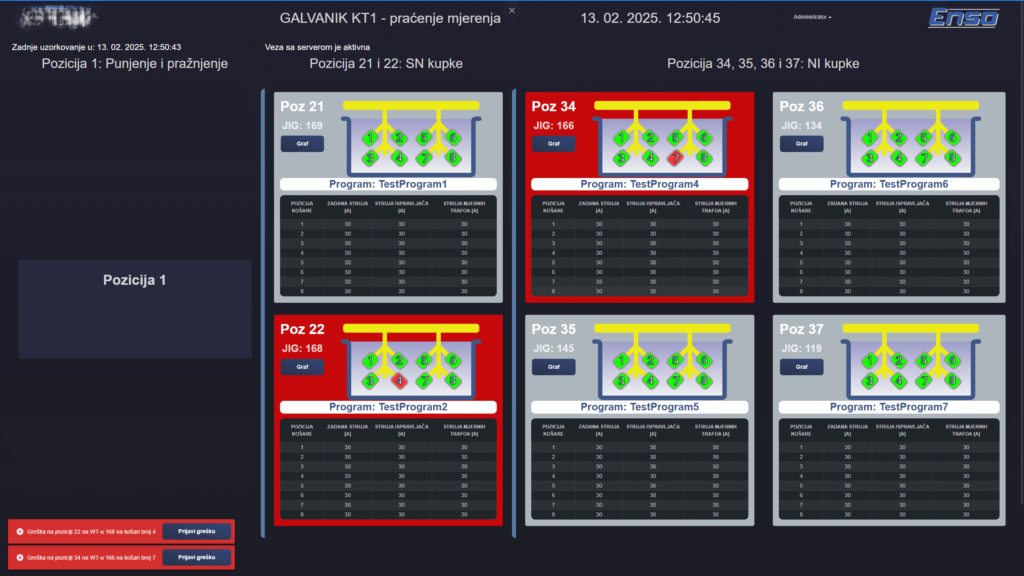
This system, developed for TDK Croatia, is a modern solution for precise monitoring of electrical parameters in the galvanization process. The project focused on real-time visualization of critical data collected from current transformers, ensuring process stability and rapid response to deviations.
Technical Specification of the System
The system is built on a real-time architecture that provides immediate insight into plant status:
- Frontend: A high-performance React application serving as the central dashboard for operators.
- Backend: ASP.NET Core with REST API implemented for historical data and SignalR (Websocket) technology for real-time data transfer.
- Database: Integration with the client’s existing database, ensuring secure storage of measurements, errors, and system settings.
Key Technical Challenges and Solutions
The main task was to convert raw analog data from the PLC into meaningful digital information available on the network.
- Two-way real-time communication: Using SignalR technology (Websocket), we enabled current data from the PLC to “flow” directly to operator screens without delay. This is crucial for detecting instantaneous current spikes or drops in tanks.
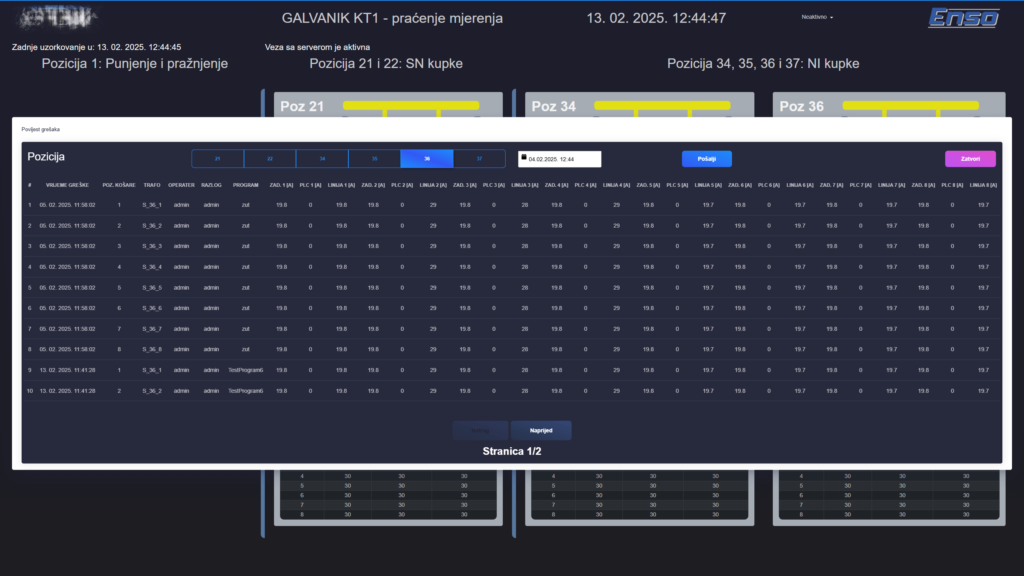
- Error management and administration: A complete CRUD system was developed for managing the operator list and classifying errors, giving the client full control over system administration.
- Advanced visualization: Dynamic graph generation was implemented, combining historical data with current measurements, allowing for easy comparison and trend analysis.
Result
The client received a robust PC application that became the primary tool for quality control. The system enables:
- Instant insight: Tabular and graphical display of current in real-time with automatic error reporting.
- Transparency: Detailed history of all alarms and operator activities, facilitating subsequent analysis of downtimes.
- Flexibility: Ability to remotely adjust process settings and alarm thresholds directly through the web interface.
Knauf Insulation, Škofja Loka, Slovenia – SCADA for monitoring material thickness in production

For the needs of the Knauf Insulation factory in Slovenia, we developed a specialized system for precise real-time monitoring of insulation material thickness. The solution was implemented as an autonomous unit (control cabinet with PLC and industrial computer) ensuring maximum reliability without dependence on external network infrastructure.
Technical Specification of the System
The system is integrated in a “compact” design, combining measurement and data processing in one place:
- Hardware: PLC device for receiving analog signals from thickness sensors and an industrial PC (Windows) serving as a local server.
- Technology stack: React (Frontend) with Redux state management, .NET Core (Backend), and a local database.
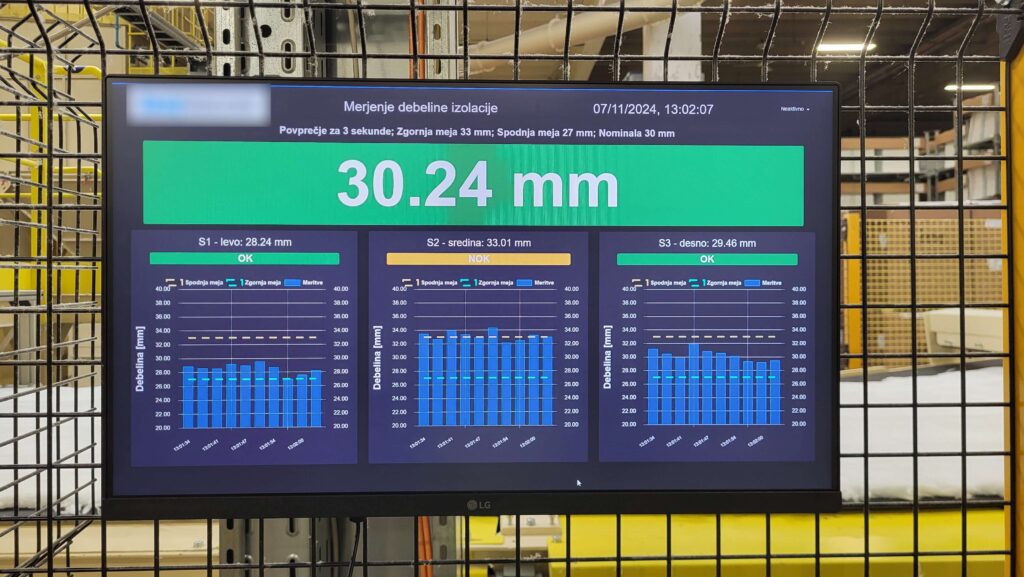
- Real-time visualization: Using SignalR technology, data is refreshed every 500ms, providing the operator with immediate insight into production stability.
Key Technical Challenges and Solutions
The main focus was on display speed and easy data export for further laboratory analysis.
- Dynamic graphical display: A system was implemented that actively draws the last 20 measurements in a “sliding” graph, allowing the operator to focus on the current trend of material thickness.
- Signal tower logic (OK/NOK): The system automatically compares the measured thickness with set tolerances and in real-time controls the light signaling (traffic light) and records the status of each measurement.
- Data transparency: Every change in system parameters is recorded in the Daily Logger, ensuring a complete audit trail of machine operation.
Result
The client received a reliable and simple quality control tool that does not require complex maintenance. Key benefits include:
- Easy data export: All measurements and parameter changes are automatically exported to CSV format on the local computer, allowing easy data transfer via USB to internal analysis systems.
- High resolution monitoring: Monitoring data at 500ms intervals ensures that no deviation in material thickness goes unnoticed.
- Autonomy: The system operates independently of the factory’s central IT system, guaranteeing stability even in the event of network outages.
Limarija Baranček, Lipovljani – System for recipe management and machine monitoring
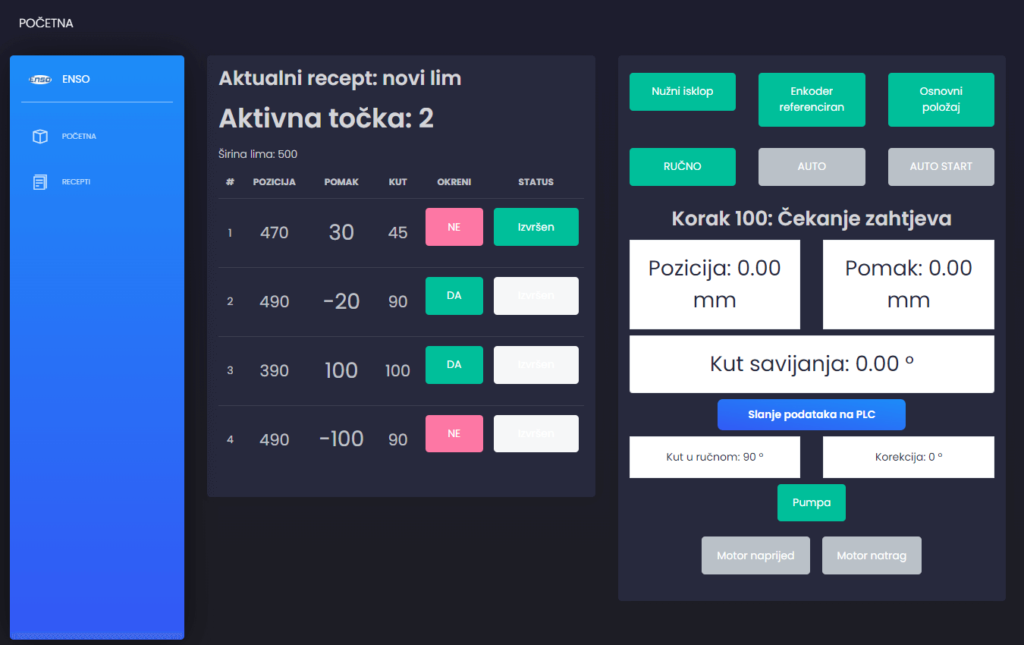
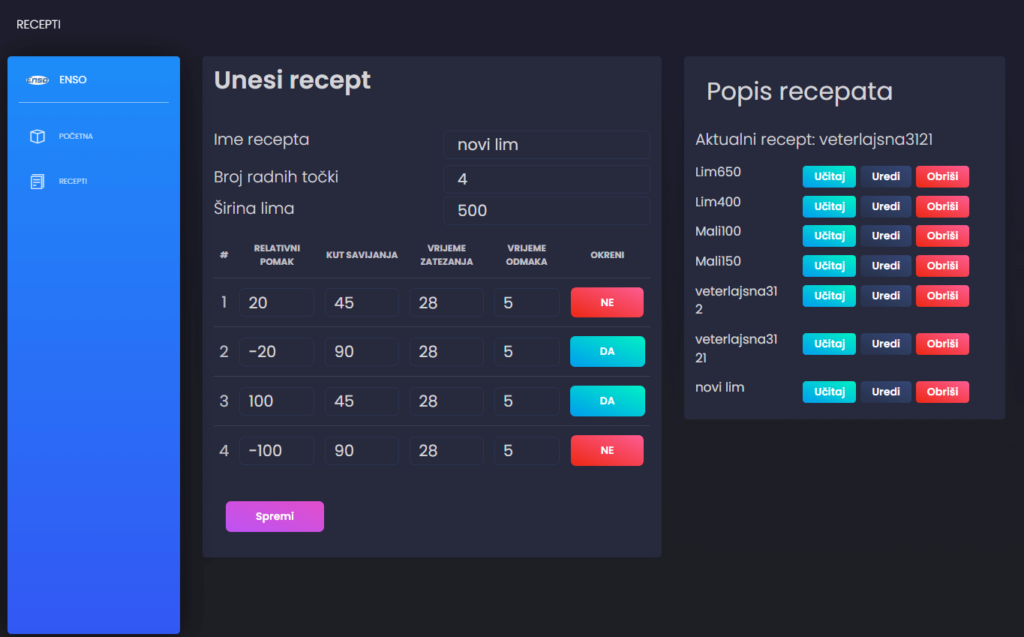
As part of the retrofit of an industrial sheet metal bending machine, we implemented a modern control and monitoring solution that completely replaces traditional HMI panels. The system enables the digitalization of production processes through advanced recipe management and real-time machine operation monitoring.
Technical Specification of the System
The system architecture is designed to combine the robustness of industrial automation with the flexibility of modern web technologies:
- Hardware: A new PLC system integrated with an industrial computer serving as the central server.
- Control interface: A React application serving as the primary interface for the operator, enabling complete control without the need for separate HMI devices.
- Backend communication: ASP.NET Core with SignalR technology for instant display of analog values and REST API for managing the recipe database.
Key Technical Challenges and Solutions
The main challenge was to organize a huge number of product variations into a clear and easily manageable system.
- Centralized recipe management (CRUD): We developed a system for creating, editing, and deleting (CRUD) production recipes. Given that sheet metal processing involves a large number of positions and parameters, recipes are stored in a structured database, which eliminates the possibility of human error during manual entry on the machine.
- Virtual HMI in real-time: Using SignalR, the application continuously monitors analog values from the machine. The operator sees every change in status and the values of the bending machine’s angle and position on the screen, ensuring precise control of the processing operation.
- Modernization through retrofit: The old machine was upgraded with sensors and control logic that communicate directly with the server database, transforming it into a system ready for Industry 4.0.
Result
The client received a digitized plant where managing complex production lists became simple and fast:
- Increased efficiency: Rapid change of machine parameters through the selection of ready-made recipes from the database drastically reduces production preparation time.
- Transparency and record-keeping: All data on products and machine parameters are securely stored and available for analysis, ensuring consistent quality for every piece of sheet metal.
- Cost optimization: By using a PC and web application as the main interface, the costs of purchasing and maintaining specific industrial hardware (HMI panels) were reduced.
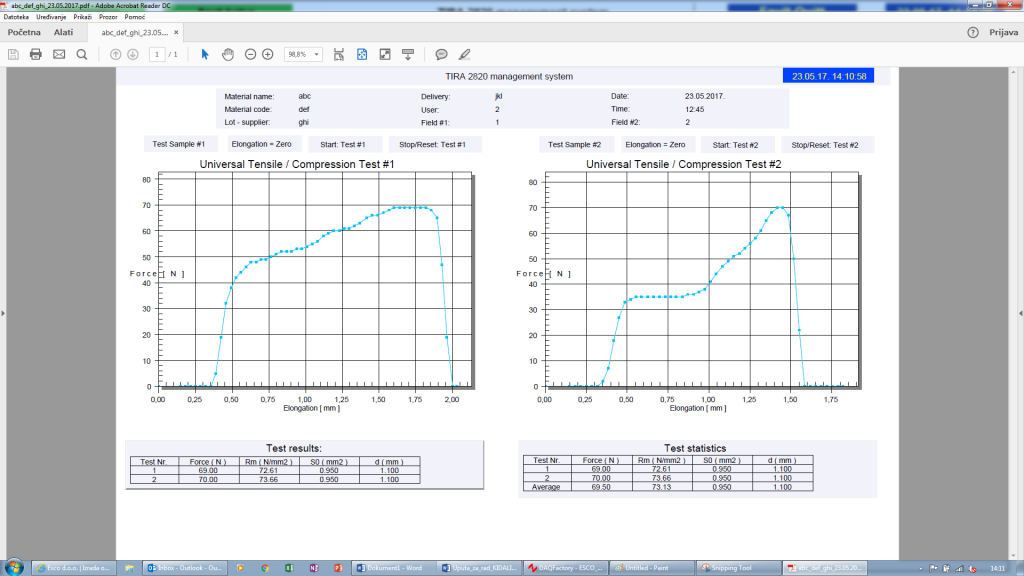
ESCO Fofonjka, Bjelovar – System for managing and monitoring a tensile testing machine

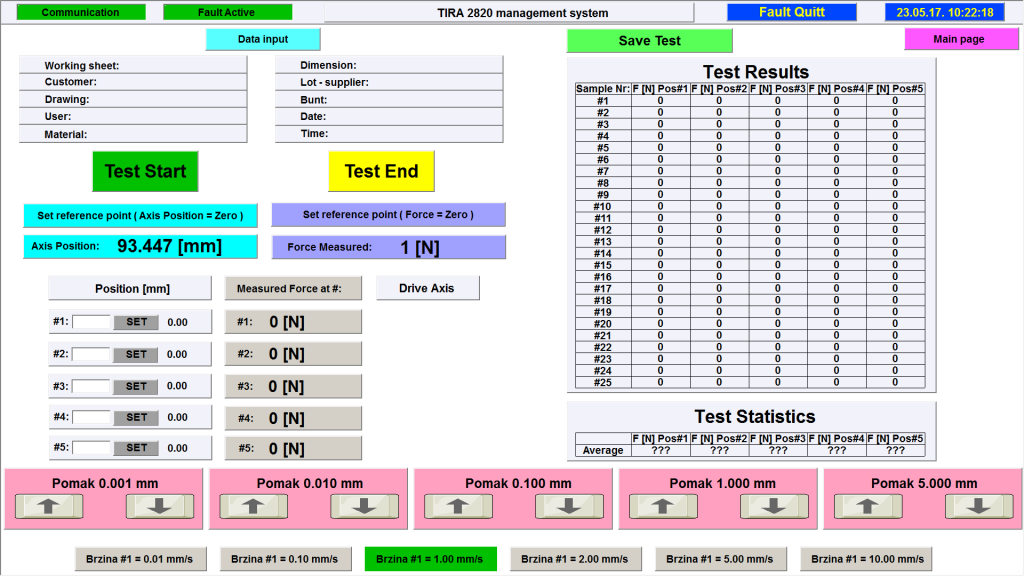
As part of the reconstruction of a material testing machine (tensile tester), we developed a comprehensive system for precise control and data acquisition. The project included modernizing the machine’s control section and implementing a SCADA interface for performing complex endurance tests.
Technical Specification of the System
The system is designed as a robust link between industrial automation and specialized software for measurement processing:
- Control logic: A new PLC system responsible for precise drive control and data acquisition from force and position sensors.
- SCADA Platform: Implementation within the DaqFactory environment, adapted for real-time visualization of dynamic processes.
- Communication protocol: Fast and reliable data exchange between PC and PLC was achieved via the Modbus TCP protocol.
Key Technical Challenges and Solutions
The main focus was on automating measurement cycles and ensuring the accuracy of test results.
- Hybrid control: A system was developed that provides the operator with complete flexibility – from precise manual control of the tensile tester via buttons to fully automated control directly from the application.
- Specialized test modules: Logic was programmed for performing various types of tests: tension, compression, tearing, and long-term material endurance tests under load.
- Force and position acquisition: The system correlates data on applied force and current position in real-time, which is crucial for correct material characterization.
Result
By modernizing the tensile tester, the client gained a modern testing laboratory with an automated documentation process:
- PDF Reports: Upon completion of each test, the system automatically generates official reports with measurement results, ready for printing and archiving.
- Increased precision: Eliminating manual data recording reduced the possibility of error and accelerated the process of issuing material certificates.
Pivovara Daruvar – Boiler room visualization and monitoring

In facilities like breweries, the boiler room is the heart of production. For Pivovara Daruvar, we implemented a system for remote monitoring and visualization of boiler operating parameters, ensuring maximum energy efficiency and a high degree of operational safety.
Technical Specification of the System
The system is based on distributed data acquisition adapted to industrial conditions:
- Data acquisition: Using RTU (Remote Terminal Unit) modules to collect analog and digital signals directly from the field.
- Communication: Data transfer via Ethernet network, ensuring a fast and stable connection between sensors in the boiler room and the central SCADA application.
- Platform: SCADA interface implemented in the DaqFactory environment, optimized for long-term monitoring of historical trends and current states.
Key Technical Challenges and Solutions
The main focus was on precise measurement of physical quantities under conditions of high temperatures and pressures.
- Monitoring critical parameters: Precise measurement of steam pressure was implemented using specialized high-temperature measuring transducers, along with real-time monitoring of water levels.
- Subsystem operation monitoring: The system monitors the correct operation of each individual boiler, the activity of feed pumps, and the status of all digital signals critical for safety.
- Alarming and signaling: Any deviation from the set operating parameters is immediately signaled by the system, allowing operators to react promptly before production downtime occurs.
Result
By digitizing boiler room monitoring, the client gained complete control over energy resources:
- Process safety: Continuous archiving of pressure and water level data enables detailed analysis of boiler room operation and prevention of malfunctions.
- Centralized overview: Operators no longer need to perform manual readings; all key parameters are available on one screen, with a historical overview of all physical quantities.
- Steam supply stability: Precise monitoring ensures stable steam pressure, which is crucial for the consistency of the beer brewing process.
